
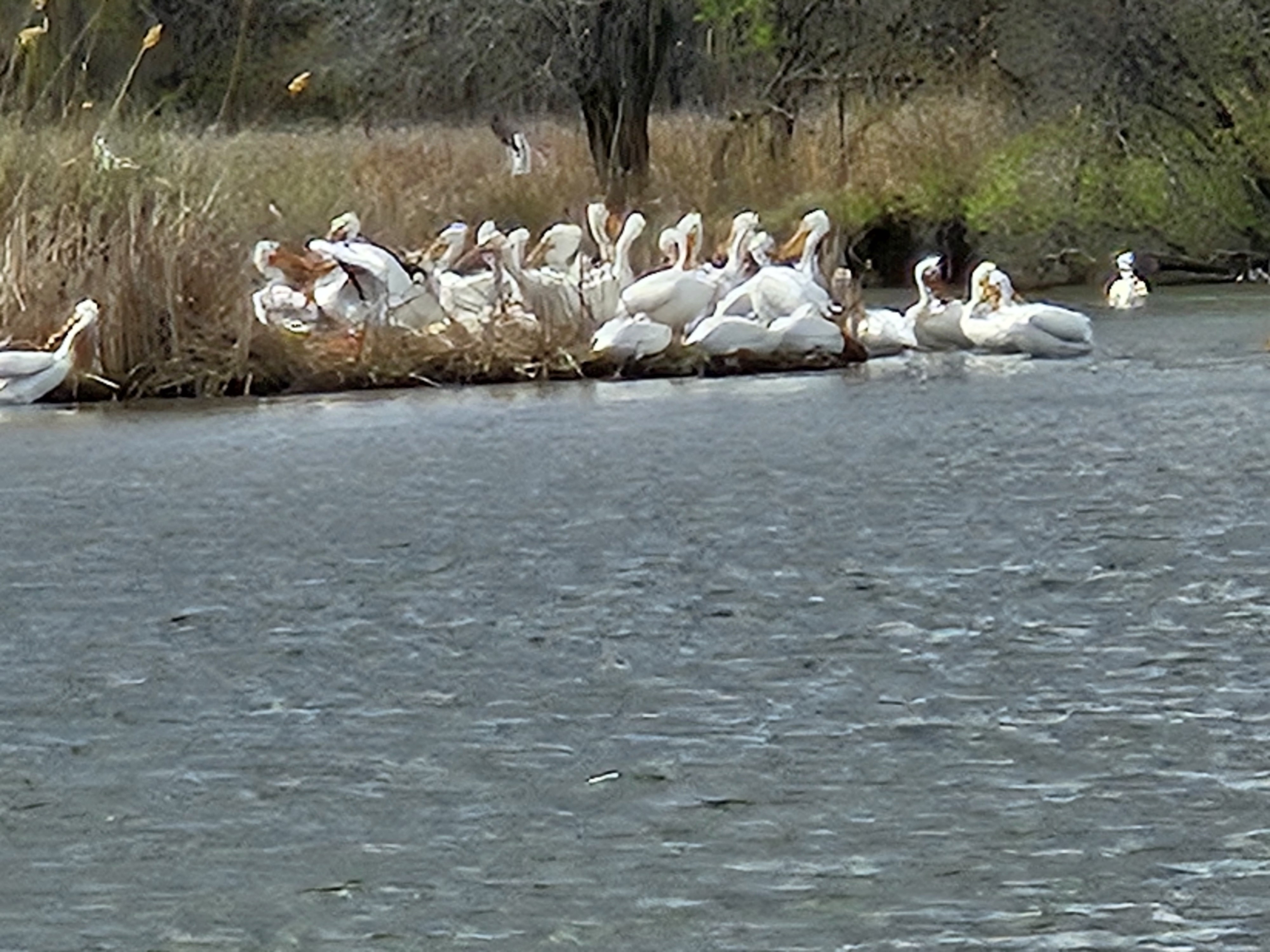
“What are they?” I whispered to myself as I walked down the side path to the lake in Busse Woods in order to get a closer look. They were birds lying, folded in, like lumps of white. Every once in a while I could catch a glimpse of black when one of the lumps would spread a wing. I could not make out whether their necks were long or short, their legs either. I went on for my walk. Rounding the bend in the trail to go by another view of an island of grass in the lake, I spotted many, many more of the white feather balls. “What are they?” I asked myself again. I took a picture and looked up large, white bird with black underwings on Google.
“Hello, young lady.” I startled a bit and turned around quickly. There coming down the path to the shoreline was an elderly man walking toward me, a pair of binoculars around his neck and a warm smile on his face.
“Do you know what they are?” I asked him.
He smiled and I noted a gleam in his eyes as he told me it was a rare sight. That the lumps of bird were sleeping pelicans. “A large group of them had arrived here over the weekend, on their migration trip. They are rare and beautiful white pelicans,” he said. “They’re sleeping right now. They arrived over the weekend, flying in twos or threes and landing on the water around the little islands. He then proceeded to take his binoculars off and hand them to me so I could share a closer look. “My good friend gave me these. Well, after he died, his wife passed on all of his birdwatching books and tools.”
“Oh, now I see their big beaks,” I cried out excitedly, as a few of the white lumps lifted their head and spread their wings. “They are so big and beautiful.” “I never thought of pelicans being by a small lake in Illinois.” He chuckled a little and told me about a few people he met up with yesterday and the day before who would say they thought they were just sea gulls and go on their way, brushing off his delight in telling them about their rarity something they were not that interested in.
“They’re on their migration trip. You would maybe see them by Lake Michigan at this time of year, but not here, in Busse Woods, not in eight or ten years,” he said. He went on to tell me more of the bird’s habits and patterns, seeming to take delight in meeting someone who was genuinely interested. “There are around a hundred of them in total. I also saw some swans over the weekend, loons, egrets, and various kinds of ducks.”
We parted ways then. I went back to my walk into the park, he to look at the first group of pelicans back around the bend. On my walk back, I ran into him again. “Did you find the swans?” I asked him. “No, I was trying to get the guys doing some fishing over there to be interested, but they brushed me off, saying that the big birds just eat all the fish.”
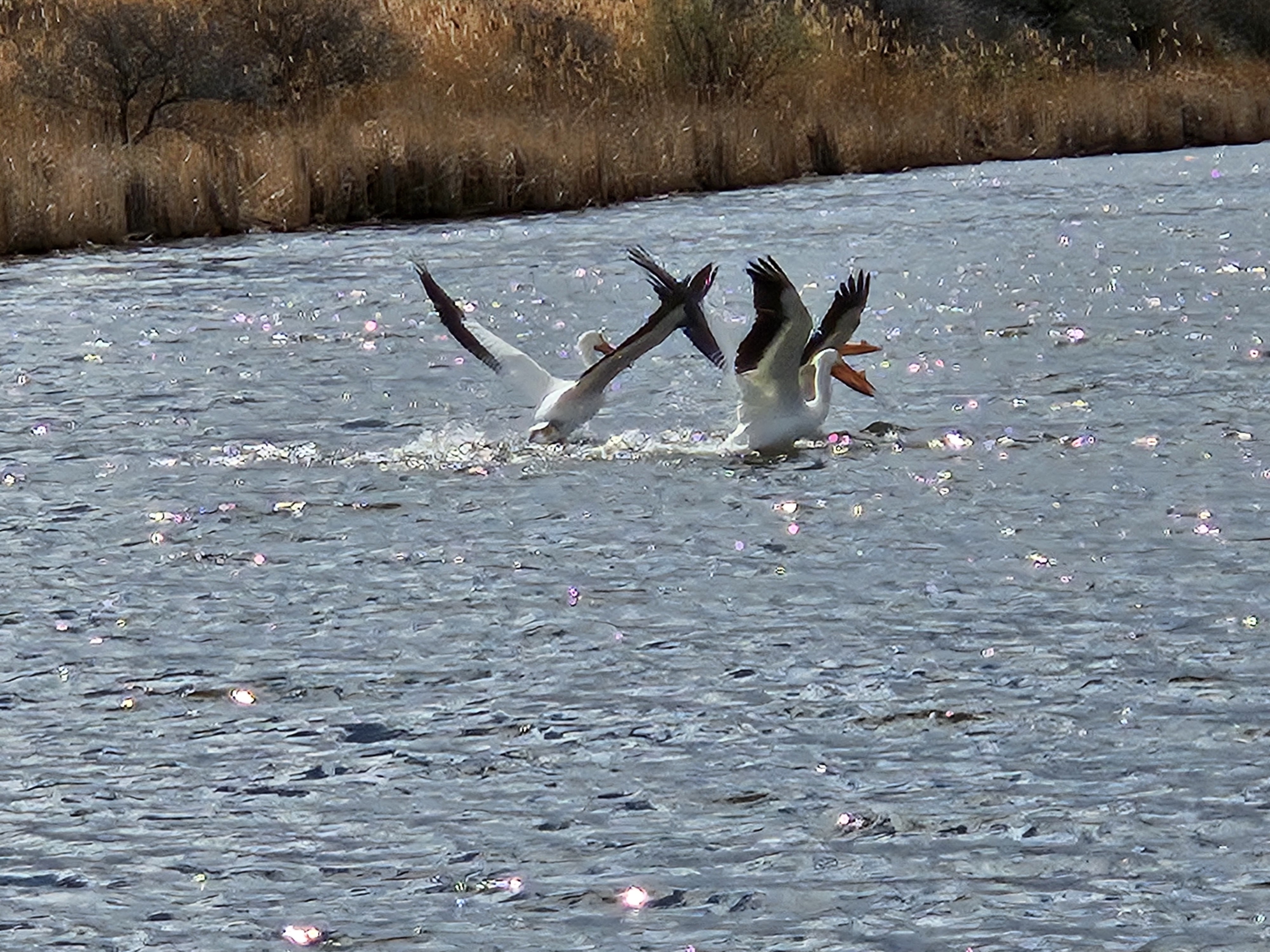
The pelicans were restless now and flying around more. “How close could you get to the shoreline,” he asked me and I led him down to the side path I had found earlier. We spent more time watching the birds, he pointing out the way they were helping each other find the fish. Both of us continuing to revel in the sight, the great beauty of the birds, the delight in being able to participate in the comradeship of such a rare sight.
Back home again, I’m still reveling in the astonishment of seeing the pelicans and sharing in the delight and knowledge of a neighbor. For such a time as this, the news of the world grew a little dimmer, the beauty of the world a lot wilder.
Even a wounded world is feeding us. Even a wounded world holds us, giving us moments of wonder
and joy. I choose joy over despair. Not because I have my head in the sand, but because joy is what the earth gives me daily and I must return the gift. Robin Wall Kimmerer
 Writing From the Margins