Elena Ferrante, the Italian author of My Beautiful Friend, has a book of four essays out titled, In The Margins: On the Pleasures of Reading and Writing. These are deeply thought out and intimately written essays about some of the influences on her disciplines of reading and writing. She writes about finding her own voice by thinking outside the established rules and language, like spilling over the red-ruled line of the right margin in her childhood notebooks, a line she was strictly taught to stay within. I can relate.
At the beginning of August I celebrated my birthday, always a good time to reflect on the past year, a year in which I’ve done a lot of experimenting with my writing voice. Like Ferrante I’ve reflected on some of the influences on my writing and reading—the ones that disciplined me to stay strictly within the margins and the ones that encouraged me to keep going outside and beyond the margins. In the third essay of the book Ferrante quotes two words from a Emily Dickinson poem, the word “History,” and the word “I.” Ferrante is intrigued how Dickinson writes of the cover-ups and shrouds we’ve been taught as the truth about certain historical stories. Dickinson then introduces the adversative “but” that unites the “I” with history to find all the hidden story that is needed. I like that. I’ve been trying to do that in my search for my own “I”, my voice that can speak my history’s truth.
This summer I was able to re-unite with dear, old friends that I haven’t seen in a long time. Friends that told stories of our history in new ways. One of these dear friends I was able to visit was a spiritual director, a mentor, and friend who is quite elderly now. Although my friend’s body is deteriorating, she retains her strong wit, wry humor, and piercing spirit. M. is someone who encouraged me to think and live and embrace a spirituality outside the margins I was taught to stay within. “Say that a little louder,” she urged me, when I told her that I’m now retired. “Tired and re-tired, is how I like to tell it,” she said. A writer and poet herself, my mentor remembered Temma (my daughter) so when I told her about trying to write the story of Temma and me, M. encouraged me, “Such a needed story to tell.” Confined to a small room in a nursing facility my friend still is actively searching and pondering questions about the history we’ve been taught with a sense of playfulness that is so bright and alive. She told us of a question she and her small group of friends came up with to ponder, “Do teddy-bears have a soul?”
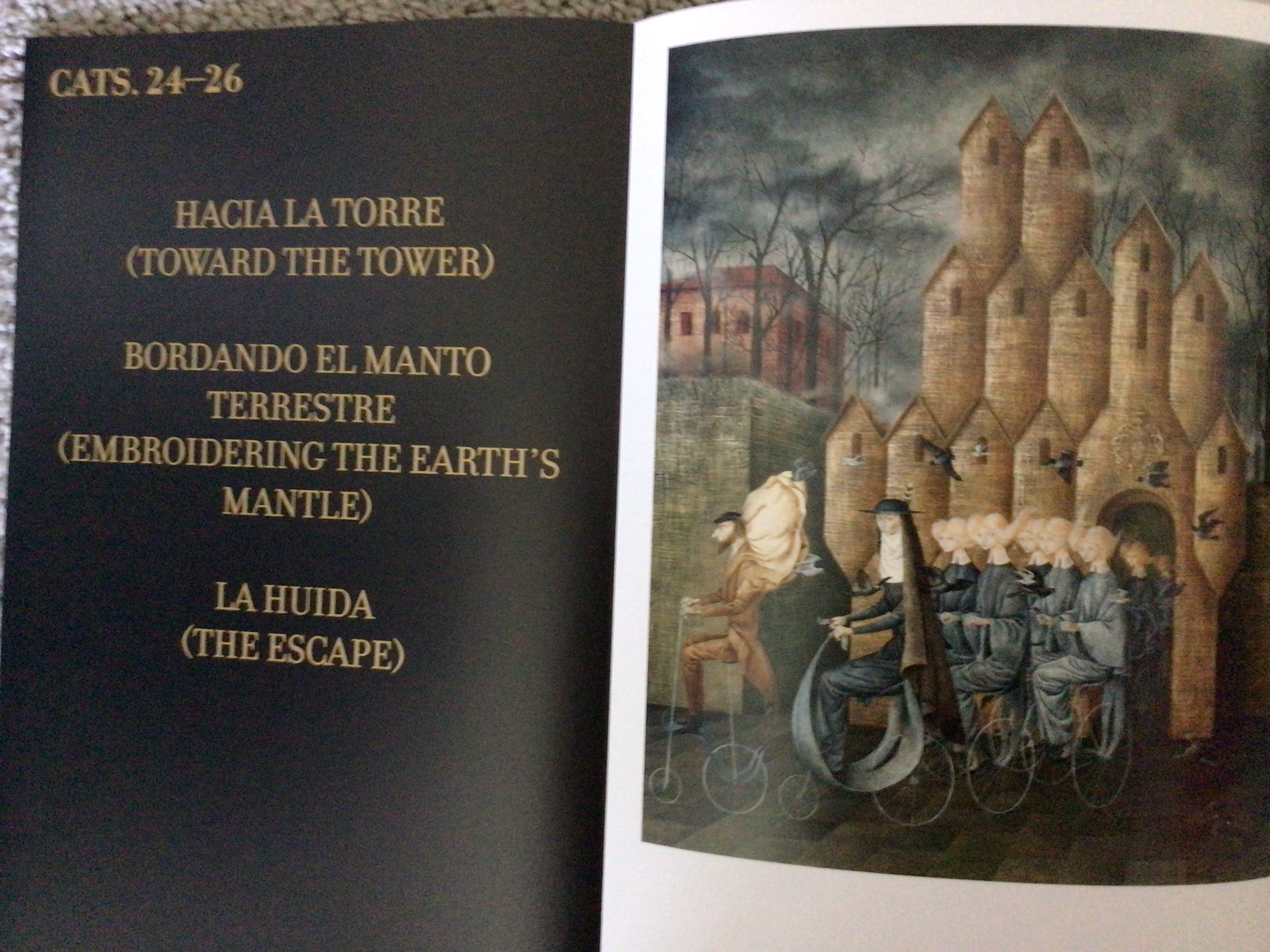
On the celebration of my birth-day, Tim and I went to one of my favorite places, The Art Institute. There, I met the artwork of Remedios Varo, another beautiful soul with a strong and fantastic imagination, arising out of intense pain and struggle. I am in awe of her work. The eyes of such characters in paintings like the triptych: Toward the Tower, Embroidering the Earth’s Mantle, and The Escape, tell a story of her “History” and her “I” that brings to everyday life around me all the story I need to escape the strict margins of cultural and religious norms that hide my voice from myself and confine it to stay within the lines.
“Magical Realism, that is how her work can be described,” Tim explains. Bringing to life the stories around us every day, that’s what my beautiful friends do with their “I” and their “History.” Writing, painting, and telling, not disguising the pain and struggle, not denying the difficulties, the mistakes made and the cruelties of strict margins placed on me, on my daughter, and on our God, but experiencing the souls of the teddy-bears, the wings fluttering around us, and the wheels always available at our feet, ready for our escape.
Thank you, Elena Ferrante, M., and Remedios Varo. I’m so grateful.


Pingback: History, and I | Writing From the Margins
Sherrie:
I respect your sacred journey so much. Thank you for sharing with me. Helene